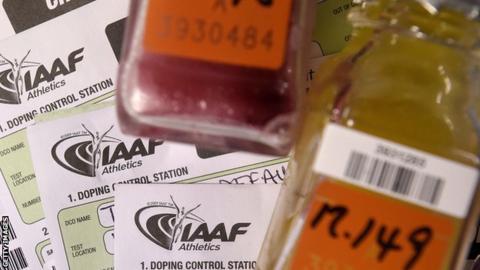
Russian track and field athletes remain banned from international competition, including the 2016 Olympics in Rio.
Athletics
chiefs have decided not to lift the suspension, which was imposed in
November following accusations of state-sponsored doping.But individual athletes can compete as neutrals if they prove they are clean.
Meanwhile, Russian pole vaulter Yelena Isinbayeva said she would challenge the IAAF's decision in court, claiming it was "a human rights violation".
Isinbayeva, 34, who won Olympic gold in 2004 and 2008, added: "I'm disappointed and angry. I am offended. Nobody defended us.
"Nobody fought for our rights and there are huge concerns over the IAAF itself and its stance on defending the rights of clean athletes.
"We are blamed for something we have not done. I will not remain silent, I will take measures. I will appeal to the human rights court."
Russia anger over ban
Russian president Vladimir Putin described the ban as "unjust and unfair".He said: "There are universally recognised principles of law and one of them is that the responsibility should be always personified.
"If some of the members of your family have committed a crime, would it be fair to hold all the members of the family liable, including you? That is not how it's done.
"The people who have nothing to do with violations, why should they suffer for those who committed the violations?"
In a statement, Russia's Ministry of Sport said it was "extremely disappointed" by the IAAF decision.
It continued: "Clean athletes' dreams are being destroyed because of the reprehensible behaviour of other athletes and officials. They have sacrificed years of their lives striving to compete at the Olympics and now that sacrifice looks likely to be wasted.
"We have done everything possible since the ban was first imposed to regain the trust of the international community. We have rebuilt our anti-doping institutions which are being led by respected international experts.
"Our athletes are being tested by the UK's anti-doping agency (UKAD) and every one of them is undergoing a minimum of three tests in addition to the usual requirements. We have nothing to hide and feel we had met the IAAF's conditions for re-entry."
IAAF president Lord Coe said "no politics" were involved in the decision over Russia's ban. He emphasised the unanimous nature of the verdict and the international range of council members.
Coe also said he was "very happy" to return to the House of Commons culture, media and sport committee to give further evidence about doping and corruption in athletics, and when he was first made aware of allegations.
Reaction from the athletics world
The USA track and field team said it supported Russia's continued suspension "to ensure clean and fair competition for all athletes".It added in a statement: "It is the only proper course of action given the compelling and powerful evidence presented to council.
"We do not believe that every Russian athlete cheated, and it is unfortunate and regrettable that some may pay a penalty for the serious transgressions of their federation."
UK Athletics chairman Ed Warner said it was imperative "no cheats slip through the net". He added: "This will allow more time for the authorities to ensure that systems are in place to protect all clean athletes who are playing by the rules.
"As one of very few truly global sports, we look forward to a time that Russia can return to competition."
Former long distance runner Paula Radcliffe praised the IAAF for taking a "strong" and "important" decision.
"They showed that they are ready to step up and fulfil their vital role for clean athletes in ensuring that all is done to maintain a fair and level playing field," said Radcliffe.
"It is now up to the IOC and other governing bodies to act. I sympathise with any clean athlete who loses out in all this but Russia plainly did not do enough to comply and showed a blatant disregard for the rules of our sport."
Former 110m hurdles world champion Colin Jackson questioned the idea of athletes being allowed to compete as neutrals.
"I think it would be really weird. For me the essence of the Olympic Games is representing your country," he told BBC Radio Wales
IAAF taskforce report - what Russia needs to do
A summary of the taskforce report states Russia must show a culture of zero tolerance towards doping in athletics.Although significant progress has been made to meet the IAAF's criteria, work still remains. In particular:
- The deep-seated culture of tolerance for doping appears not to have changed. The head coach of the athletics team and athletes appear unwilling to acknowledge the extent of the doping problem.
- A strong and effective anti-doping infrastructure capable of detecting and deterring doping has still not been created.
- There are detailed allegations that the Ministry of Sport has orchestrated systematic doping and cover-ups.
- However, the report does state that if individual athletes can convincingly show they are not tainted by the system, they will be allowed to compete in international competition, not for Russia but as a neutral athlete.

No comments:
Post a Comment